Baby Passport Photo Requirements: A Parent's Complete Guide
September 3, 2026
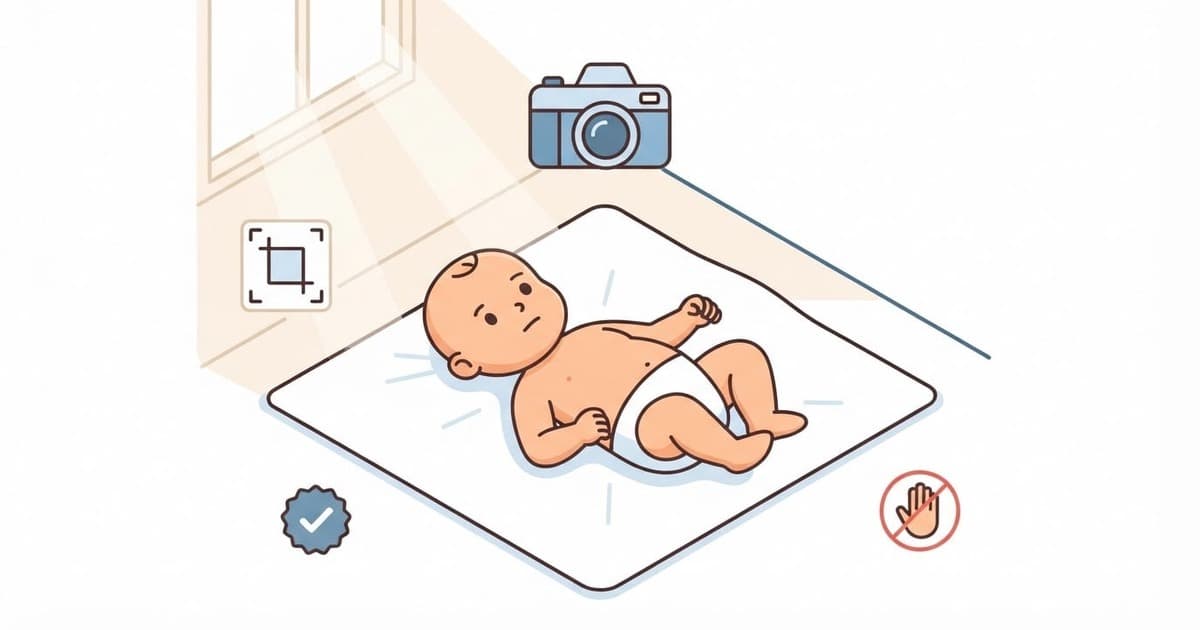
Getting a passport photo for an adult is annoying enough. Getting one for a baby who can't sit up, can't follow instructions, and definitely can't hold a neutral expression on command? That's a different kind of challenge entirely.
The good news is that background and lighting are things you can fully control at home. The part that takes patience is getting your baby to hold a natural expression: there's no official exception for that the way there is for eyes, even if reviewers do cut babies some practical slack. Getting them to actually look at the camera is its own challenge too, though more on that below. Once you know how to set up the shot, taking a compliant photo at home is very doable. Here's how.
Why baby passport photos are so hard
With an adult passport photo, you can ask someone to look at the camera, relax their face, and hold still for a second. With a baby, none of that is on the table. They squirm, they startle at flashes, their eyes wander, and the moment you finally get a good angle, they decide to yawn.
On top of that, most of the usual tricks for framing a photo (having someone hold the baby steady, propping them up with a blanket, using a bouncer) risk putting a hand, arm, or toy into the frame, which can get the photo rejected. It's a photo you have to get right within very specific limits, using a subject who has no idea what's happening.
What's actually required
Requirements vary slightly by country, but most infant passport photo rules share the same core elements:
- Plain, light background. White or off-white, with no patterns, shadows, or other objects visible.
- Eyes open, facing the camera, with one confirmed exception. The face has to be pointed at the camera in every country, no exception for babies. The US officially allows an infant's eyes to be partially or fully closed (newborns especially), and the head may be discreetly supported or tilted. Worth checking whether your own country offers the same leniency before you count on it.
- Neutral or natural expression, no formal exception for babies. Unlike the eyes rule above, there's no official carve-out for expression, though reviewers do know an infant can't hold a pose on command and judge accordingly. A crying or wide-open-mouth shot is still a real rejection risk almost everywhere, the US included.
- No other people, hands, or props in frame. No parent's hand supporting the head, no pacifier, no toy peeking into the corner. This one is consistent everywhere.
- Recent photo. The rule is the same as for adults: usually taken within the last 6 months, no shorter window just because it's a baby. That said, babies change fast, so it's worth using the most recent shot you can.
- Correct size. Passport photo dimensions differ by country (for example 2x2 inches in the US, 35x45mm in many other places), so check your country's exact specification before you submit anything.
- No digital editing, filters, or AI. As of January 2026, the US State Department rejects any passport photo that's been AI-generated, AI-enhanced, or digitally retouched, and most other countries have similar bans on synthesized or "beautified" images. Take the photo straight from a camera and leave it alone.
Since the exact size and formatting rules differ from country to country, always check your own passport agency's current guidelines before submitting.
Why baby passport photos get rejected
Knowing the common failure points ahead of time saves you a resubmission:
- A hand, arm, or blanket edge visible in the frame
- Shadows falling across the background from overhead lighting
- Photo blurry from movement
- Background isn't plain (a car seat pattern, a crib rail, wallpaper)
- Photo is cropped too tightly or too loosely for the required size
Background and framing issues are largely avoidable with the right setup: wrong color, shadows, something poking into the corner of the frame. Expression is the harder variable, since the standard isn't relaxed for babies, so timing and patience matter more there.
How to take a baby passport photo at home, step by step
You don't need a studio. You need a plain white sheet, some natural light, and a few minutes when your baby isn't mid-meltdown.
- Lay a plain white sheet or blanket flat, either on the floor or over a firm, flat surface like a changing table. This becomes your background.
- Lay the baby down on their back on the sheet, or if they're a bit older, try propping them semi-upright in a car seat that's fully covered with the white sheet so no fabric or straps show. Newborns can't hold their own head up yet, so it helps to have someone support their head from out of frame to keep it from wobbling; crop the photo tightly enough afterward that the supporting hand doesn't show at all. That still satisfies the "no other people in frame" rule covered above, since what matters is what's actually visible in the final photo.
- Position yourself directly above, and don't get too close. Shooting straight down avoids the angle distortion you'd get from a tilt, and staying a few feet back avoids the wide-angle distortion phones create at close range. Zoom in or crop afterward if you need to, rather than closing the distance.
- Use natural window light rather than an overhead lamp or flash. Position your baby near (not directly in) a bright window so the light is even across their face, without harsh shadows.
- Take a burst of photos, not just one or two. Babies change expressions every half-second, so you'll want a dozen or more shots to pick from.
- Check the background after each shot, not just the baby's face. Catching a stray hand or toy at the edge of the frame now is much easier than digging back through dozens of photos later.
Getting the eyes-open, neutral shot
Timing matters more than technique here. A few things that help:
- Shoot right after a feed, when babies tend to be calm and alert but not yet sleepy.
- Avoid nap time, obviously, but also avoid the 20 minutes before it, when babies get fussy.
- Have a helper make noise from just above the camera, outside the frame, to get the baby to look toward the lens without anyone appearing in the shot.
- Be patient with newborns. Very young babies often keep their eyes closed most of the time, so it can take many shots to catch a moment with their eyes open. In the US, that's explicitly fine under the official infant exception; elsewhere, you'll just need to keep trying until you catch one.
Cropping and formatting
Once you have a shot you like, it still needs to be cropped and sized to your country's exact passport photo specification, with no visible people or objects other than the baby. In the US, that means an overall 2x2 inch photo with the head measuring 1 to 1 3/8 inches from chin to crown (full US photo requirements here), and eyeballing that in a generic photo editor is easy to get wrong.
What most parents actually do is skip the DIY crop: bring the photo file to a pharmacy or shipping store (CVS, Walgreens, and UPS/FedEx Store locations all print passport photos in the US) and ask for a passport photo print. They size it to spec on their own equipment for a few dollars, far more reliably than doing it by eye. Since a baby's first passport always goes through the paper DS-11 application rather than online renewal, there's no photo-upload tool to pre-check it against the way there is for adult renewals, so it's worth getting the print right the first time. Check whether your own country offers an equivalent print service or online checker before you submit.
FAQ
Can I hold my baby for the photo? Only if you're completely out of frame, including your hands and arms. Many parents lay the baby down instead, since it's easier to keep any part of yourself from sneaking into the shot.
What if my baby won't stop crying? Even in the US, crying isn't officially exempted the way closed eyes are: the confirmed infant exception covers closed eyes and a supported head, not expression. A crying or wide-open-mouth shot is a real rejection risk almost everywhere. Wait for a calmer moment, or take enough shots to catch one with a natural expression.
Do requirements differ by country? Yes, meaningfully. Photo size, digital file specifications, and even acceptable expressions can vary. Always confirm the specific rules for the passport you're applying for before submitting.
Can I use a photo I took on my phone? Yes. Just don't get too close: phone cameras use a wide-angle lens that can distort facial proportions at close range, making the face look rounder or the ears smaller than they are. Keep the camera a few feet away rather than right up against your baby's face, and crop in afterward if you need to. Formatting the shot to spec afterward is usually the harder part, not the photography itself.
The takeaway
A baby passport photo is one of those small tasks that feels harder than it should, mostly because your subject has zero interest in cooperating. Some countries relax a few of the adult rules for babies (the US allows closed eyes and a supported or tilted head, for instance), but the expression standard itself usually isn't one of them: natural, non-exaggerated is still expected almost everywhere. What's universally less forgiving: no props, no hands, no exceptions on background, and no digital editing.
Get the setup right (plain background, good light, someone helping from behind the camera) and you'll likely get a usable shot within your first few dozen tries. Format it correctly, and you're done.